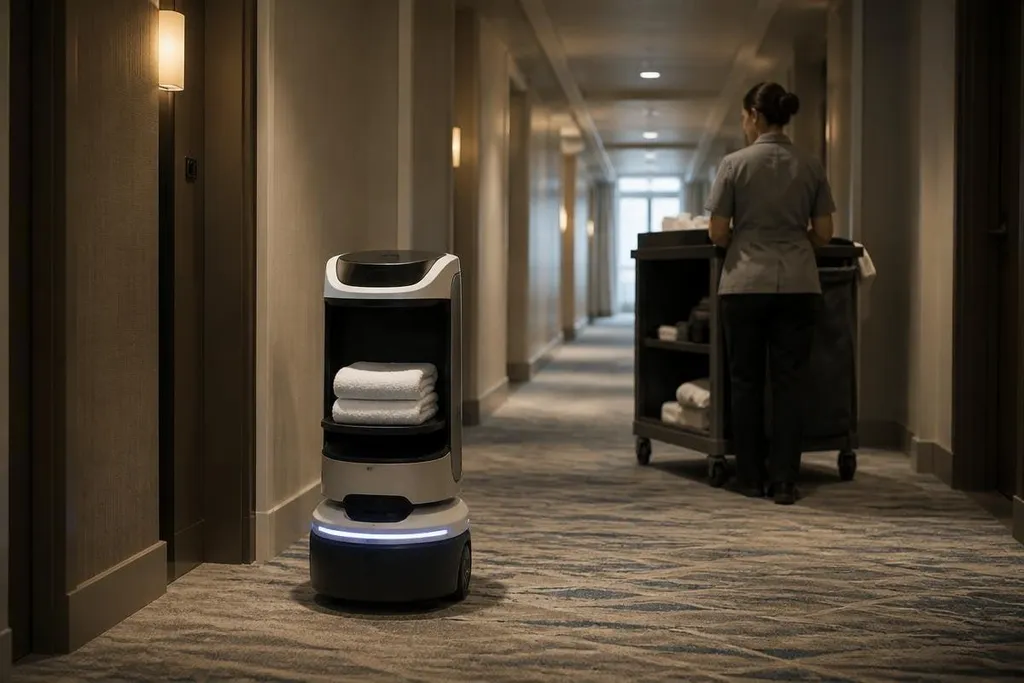
A hotel robot used to follow a fixed route and stop when the hallway changed. AI lets it read camera and sensor data, choose a safer path, and adjust its task as guests, carts, and doors change position. The useful shift is practical: less remote control and more work completed without staff intervention.
- Rooms become tasks: software can split delivery, inspection, and cleaning into smaller actions.
- Hallways become changing spaces: cameras, LiDAR, and wheel sensors help the robot avoid people and objects.
- Limits stay visible: a robot still needs clear rules, working lifts, and staff support when conditions fall outside its training.
From fixed routes to changing spaces
Older service robots can work well in a mapped building. Their software stores a route between places such as the front desk, a service area, and a guest room. That route becomes less useful when a housekeeping cart blocks the corridor or a guest leaves a suitcase near the lift.
AI helps the robot compare fresh sensor data with its map. LiDAR measures distance with laser pulses, while cameras help classify objects and spaces. The robot can then slow down, choose another path, or wait for the route to clear.
That change matters to a hotel manager because the building rarely stays still during a shift. A route that works at 9 a.m. may need a different path at 3 p.m., when luggage, linen carts, and guests fill the same floor.
The robot needs a task model
Movement is only one part of hotel work. A delivery robot also needs to know what it carries, where it should stop, and when the task is complete. AI software can link those steps to a hotel system through an application programming interface, or API, which lets two software systems exchange instructions.
A guest may order towels through the hotel app. The system can send the room number and delivery request to the robot.
The robot then checks its map, travels to the room, calls the lift through a connected control system, and alerts staff or the guest when it arrives.
The same approach can support inspection work. A camera can record a room after cleaning, while software checks for visible objects on a floor or a door left open. That does not replace a human inspection in every case. It gives staff a repeatable first check and sends unusual results to a person.
For a hotel manager weighing an AI service robot, hotel robotics reporting from Robot24.com puts the robot’s task beside its test setting and staff handoff. That record keeps the discussion practical: where AI helps staff, and where it creates another task.
Where AI helps staff
Hotel robots make the most sense when they take on repeat trips that interrupt staff work. Supply runs can move items between storage and guest rooms, while a worker stays with a guest or prepares another room.
The value depends on the handoff. Staff need a clear way to load the robot, check the order, and deal with a failed delivery. A screen, phone alert, or control panel can show the task state, but the hotel still needs a person who owns the next step.
Voice systems bring another layer. A robot may accept a spoken request, but background music, accents, poor microphones, and private guest details can affect the result. Hotels need rules for what the robot records, where that data goes, and how long it stays there.
What still fails
AI does not remove the hard parts of hotel buildings. Elevators may lack a robot interface. Fire doors may close between floors. A low battery can stop a delivery halfway through the route, and a crowded lobby can confuse object detection.
Training data also has limits. A robot that works well in one hotel may need new maps, task rules, and safety checks in another. Different floor plans and lift controls can turn a working pilot into a long setup job.
I’d judge a hotel robot by completed tasks per shift, not by a smooth demonstration.
A practical buying check
Use these questions before a hotel pilot:
- Name the task: choose one repeat job, such as towel delivery or linen movement.
- Count the handoffs: record who loads, starts, checks, and closes each task.
- Test the building: run the robot through lifts, fire doors, narrow halls, and busy lobbies.
- Set a failure path: decide when staff take control and how the guest gets an update.
- Check the data: ask what cameras and microphones record, where files are stored, and who can access them.
- Measure the shift: compare completed trips, staff time, stopped tasks, and battery charging time.
A useful pilot should produce those numbers within the hotel’s normal work, not in an empty corridor. Until a robot can handle the building’s lifts, doors, people, and staff handoffs, AI remains a support layer rather than a replacement for hotel operations.